Hi Glenn and Welcome,
I actually do think this is important for motion picture cameras, let me give a simple example: black, brown or dark skin typically absorbs much more light in the low end of the spectrum:
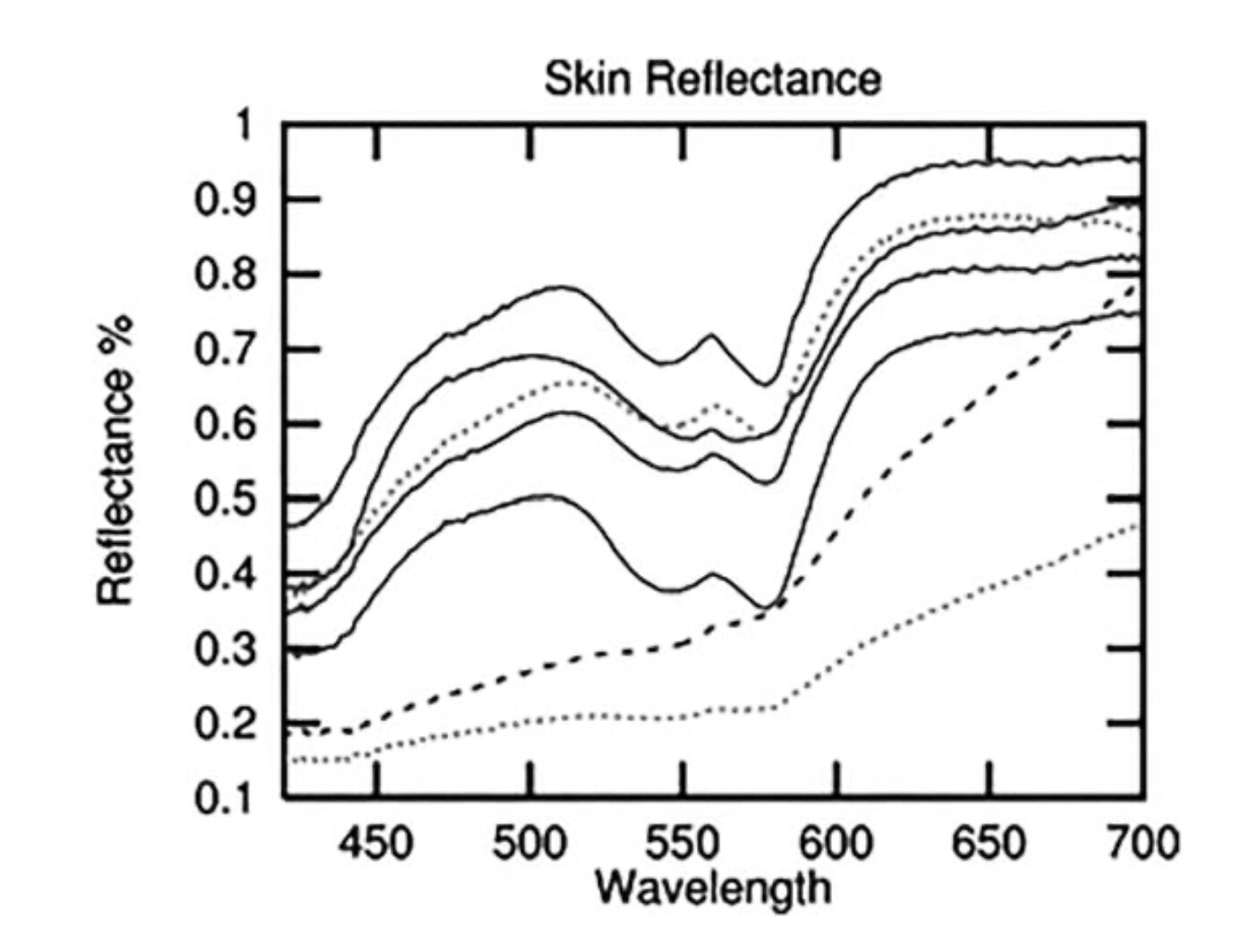
Given that motion picture cameras are mostly designed toward producing pictures of people, it makes sense to ensure that they produce good skin reproduction, e.g. higher transmittance of higher frequencies. It has effectively been a concern with film for decades already. It is also an important consideration for the lighting side of the industry, @TimKang could comment on this specific point.
Similarly, cinema lenses tend to be much softer than DSLR lenses: It is not because they are bad, quite the opposite, producing softer and warm skin is actually a quality! It is easy to see why an actress would prefer to be represented through the softness of an ARRI Signature Prime compared to the analytical sharpness of a Canon Series L lens! We did some tests a few years ago with some ARRI Master & Ultra Prime on a RED Helium and a simple Canon 18-55 Kit Lens was sharper at any aperture.
Motion picture cameras are art producing devices first; if they are biased toward a particular objective, it is fine, the industry has been doing that for decades. Even machine vision cameras are optimized for a particular purpose.
It is certainly doable, I have used Finlayson (2015) linked above by @Lcrs for machine vision cameras (and many other use cases). More complex transforms are trickier because they might be slower, harder to implement in hardware (if possible) and are often not exposure invariant which makes them useless for most applications.
Cheers,
Thomas